Guard-Daddy


     Below are a few weak illustrations of what we are seeing a couple places along the creek.  The bluegill will spawn from now until way through the summer. Before and after eggs have been placed in the creek bottom, the male will guard the nest diligently.  The nest featured here takes up about a square foot of cleaned gravel where the fish has removed all algae and the diatoms which make up most of the creamy white "scum" across the floor of the creek and the pool into which it flows.  These fish have chosen a spot right at the confluence of creek and pool, on the downstream side of a boulder.  The only other bluegill nest in the area likewise is situated on the downstream side of a boulder.
     The individual bluegill here is small, about five to six inches long, with aqua-blue lighting up where the sun shines on its fins and tail.  A faint reddish ring circles its eye.
     Most of the time, the male here is chasing away any other fish that swims close to the nest.  When it is not feeling threatened, it sometimes appears to stand up on its tail and flap it back and forth as if sweeping the nursery floor of silt.
The obscure view of a bluegill's nest, center of the photo.

Male Bluegill Guarding Its Nest

A short movie, featuring a nervous father protecting his childless nursery in the middle of a stream.


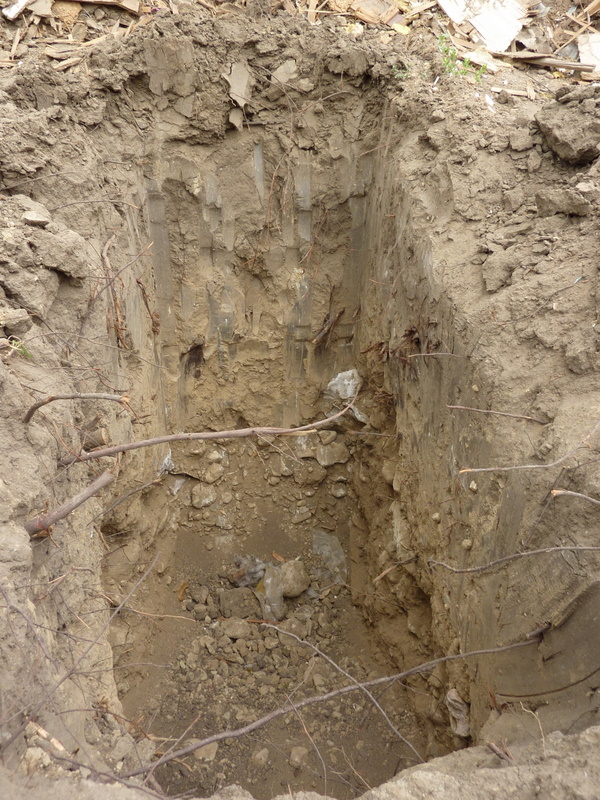
Up the hill from the Creek, we have had test holes dug where we hope to intall a septic tank and field.  This photo is meant to show the soft sandy loam down for about five feet where rounded river stones take over.

Still don't know what this fossil of leafy swirls might be. 


Within the Stonefiled near the Creek, hundreds of these sorts of rocks can be found.


More of the same riffle bugs.


The rear-end view of a honey bee feeding on water willow blossom.


Venus' Looking-glass (Triodanis perfoliata) 


The cricket frogs have taken on a greener color than when we saw them earlier in the season.

Dewberries almost ripe.


This is a difficult one, based solely on the photo.  It could be a Clippedwing Grasshopper (Metaleptea brevicornis) or a Cattail Toothpick Grasshopper (Leptysma marginicollis) or some other.  (Anybody have a suggestion?)  It was found in the short bushes near the west side of the Creek.


Priest Cave

Notice the obvious here?

Deeper into Priest Cave.
      A few days ago we posted an entry which featured some of these cave photographs.  At the time we thought the cave might have been the home of a mountain lion.  Perhaps we were wrong.  After careful study and research of some big books, we are ready to announce the discovery of an ancient Priest's Cave.  We now refer to it as "Priest's Cave" instead of "the hole in the boulders where a cougar might have stayed."
  One of the first clues is the presence of what we call a "sun dagger."  You can see it in the photo below.   

Could a mountain lion REALLY be responsible for this?  Hardly.  Priests of an ancient cult remain our only answer.
     Though we are prepared to accept some coincidences as merely coincidences (like having not only ONE Negro living in the White House now, but FOUR Negroes and all at the same time), careful investigation of the following data leads us to a profound conclusion.  Data to consider:
  1. The angles of dark black lines superimposed on the photograph above match those in the map below.

2. Notice the ley lines in the map below. If you follow each line real close, you will see that it eventually meets up with EVERY OTHER LINE.  And the point at which they all meet is EXACTLY at the spot where the Priest's Cave is. If only one of the ten lines had gone off in another direction, we would have been skeptical.  But EVERY SINGLE LINE without exception converges at the one spot on the globe where the Priest's Cave is.


Here's what we read about ley lines from a scholarly website (http://www.angelfire.com/in/RajunasRefuge/leylines.html):


Alfred Watkins, discovered leylines in 1921 from his realization that a series of straight lines could link all of the Earth's various landmarks into a network of ancient tracks. "Watkins believed that this alignment could not be due to mere chance. He believed that prehistoric man had deliberately made the tracks as a sort of road network, using the various landmarks as sighting points. Many of them are situated on hilltops where they could be seen against the horizon, and thus made excellent reference points for the Neolithic or Bronze Age traveller. He first voiced his discoveries in public at a slide-show and lecture to fellow members of the Woolhope Club where, although treated with some scepticism, they were well received and aroused keen interest. 

      3.  Though there are plenty of other caves on the property, any of which COULD HAVE been the Priest's Cave, this is the ONLY one that is.  In other words, it is the ONLY cave with a sun dagger and the uncanny angles.


  4.  There is great consistency with this theory and that which is held by many other scholars. Below is an excerpt from one of these scholars.  You can find more that he has written on the subject of Ley Lines at his website: 


http://www.vortexmaps.com
[you really have to see this website to appreciate what we are doing here]


     "Vortices appear to be points of power or energy on the Earth, and ley lines are the relationships between those points. An analogy might be that the vortices are accupressure points. and the ley lines between them are meridians on the skin of the body of Mother Earth.
     However, reality is likely not so simple. My theory is that there is a template for this physical reality in a world existing concomitant with this one, and that template is geometric, or mathematical in organization. Matter is here, then not here, moving back and forth between implicate and explicate reality, as described in the theories of David Bohm, a contemporary and colleague of Einstein. This template for matter as we experience it in this explicate reality (the physical world) is in implicate reality, as also described in the "morphogenetic fields" of Rupert Sheldrake, a biologist at Cambridge in the 1960's.2Joel Goldsmith, a metaphysical healer, often alludes to the same kind of system in his books, Jane Roberts mentions It in the Seth books, and Swedenborg Wrote of the correspondence between this world and that of the spiritual in Heaven and Hell, paragraph 90.
     If this is what is, then it's possible that the template for our Earth 'in that unseen reality is crystalline 'in organization. Furthermore, that crystalline matrix seems to be similar to a geodesic dome--a series of triangular shapes fit together to form the skin of a sphere. The joining on the surface of the Earth at the apexes of these triangles are points of energy focus, the vortices of the Earth. Some of the principal lines of force Join -mg these vortices, called "ley lines, " form triangular shapes between vortices.
     At these foci of energy Earth, as it forms 'in explicate reality (our world as we sense it), reveals the presence of these foci, or vortices, by -nations of geologic significance: These formations are volcanoes, high mountains, hot springs, mineral deposits, ends of sand spits near the ocean, sea mounts, forks of rivers, river mouths, large falls, deep gorges, rock outcroppings, and possibly others. Some dams are located on vortices, and often mineral deposits, especially gold, denote a vortex. There is a whole swirl of vortices around and near the Golden Gate Bridge, and these might be the coming together of several faults--many ley lines follow the great faults and waterways on the surface of our earth.
     This system of vortices and ley lines is not a new idea. Sacred temples of the ancient world around the Mediterranean are located at powerful vortices, and drawing lines between them will bring out patterns of triangles. The Indians in the American Southwest as well as those in Peru and other parts of South America located their cities and the roads between them on vortices and ley lines, which look Like so many spokes and hubs. The Chinese practice the ancient science of geomancy. "The Olde Straite Pathes" of England,3 the location of Stonehenge and it's relationship to the Great Pyramid, Glastonbury and the myth of Avalon correlate to vortices. I'm sure there are many more examples throughout the world."
     Carefully read that last line.  Yes, here at Priest Cave we have another example of the sacred ley lines.  Ancient Indians came over Here a long time ago.  Some of them settled in the mountain lion's den because they recognized the sun dagger.
     Below are some photographs of another sun dagger.  This one is in Chaco Canyon or somewhere like that.  If the ancient Indians who came to our Priest Cave knew of the other sun dagger, then their settlement here is all the more striking.  But if they did NOT know about the other sun dagger, how did they recognize THIS sun dagger?  Either way, the fact is truly mysterious.
     
http://www.angelfire.com


"The Sun Dagger  site, near the top of Fajada butte, revealed the changing of the seasons to Anasazi astronomers a thousand years ago. Its secret was lost around 1250 AD, when the ancient people abandoned Chaco Canyon. Then in 1979, an artist was studying petroglyph art at Chaco when she noticed that a slender beam of sunlight passing between two rock monoliths bisected the center of a spiral-shaped symbol on the exact day of the summer solstice."


Notice that this cave nearby Priest Cave has none of the hallmark signs of mystery.
No sun dagger.  No uncanny angles.  Complete absence of religiously-placed rocks.
 A clear contrast.


     The following was copied from another reputable website.  Please study what it has to say about ley lines, too.
http://home.hiwaay.net/~jalison/index.html


"The relationship between the distances from Angkor Vihear to the Great Pyramid and from the Great Pyramid to the Nazcan Hummingbird is also a precise expression of φ:
4,754 x 1.618 = 7,692
Because the Hummingbird and Angkor Vihear are antipodal sites, with a distance between them of one-half of the circumference of the earth, two Golden Section relationships between these three sites are shown by the circumference of the earth along the line of ancient sites:
4,754 x 1.618 = 7,692
4,754 + 7,692 = 12,446, and
7,692 x 1.618 = 12,446
These Golden Section relationships may also be diagramed on a straight line:
The line of ancient sites is a line, from the perspective of the first illustration in Part One, and it is a circle, from the perspective of the azimuthal projection above. The line and the circle are found in the greek letter φ and the number 10. Zero and one are also the first two numbers and the only two numbers in the binary code.
The φ relationships between these sites are reflected repeatedly in the first 500 Fibonacci numbers. The first three prime numbers, 2, 3 and 5, approximate the intervals along the circumference of 20%, 30% and 50%, between these three sites. This same percentage of the circumference relationship, accurate to three digits, is found in Fibonacci numbers 137-139:
Percentage of circumference:First three digits of Fibonacci numbers:
Angkor to Giza: 19.1%#137: 191... (Prime)
Giza to Nazca: 30.9%#138: 309...
Nazca to Angkor: 50.0%#139: 500...
The next prime Fibonacci number after #137 is #359. The distances between these sites, in miles, is reflected by Fibocacci numbers 359-361, accurately to five digits:
Distance between sites:First five digits of Fibonacci numbers:
Angkor to Giza: 4,754 miles#359: 47542... (Prime)
Giza to Nazca: 7,692 miles#360: 76924...
Nazca to Angkor: 12,446 miles#361: 12446..."


     We will continue to explore Priest Cave and post our findings as we know more.

Road to The Creek

     Sunday morning.
     It’s middle April, and according to a quick estimate, the fifteen hundred fortieth  Sunday morning since I quit going to church and started spending my holy day of the week outside among the marsh birds, wildflowers, creeks, grasses, and pines.  Still, whatever my thoughts now are concerning religion, one thing is for sure: Sunday mornings are sacred.  I’ve occasionally tried working or watching television on a Sunday morning, but I cannot.  Even agnostics know what sin is.
     So I drove down to The Creek for some sunshine, water, and wind.  I love wind in the morning.  Not a “breeze,” but a wind (breezes are for Romantic poems—real air is a wind).  Grass-stem and horse-mane wave to its prompting.  The presence of morning wind is one of about ten ways I can know I’m really alive.  
     But before I even arrived at Church, I passed through scenes from a world that little resembles any sort of Paradise.  Three miles from our house, I drove up on a twenty-something year old man hiking into town and not quite walking the white line.  A car would approach him, and he'd stumble down the ditch slope like a drunk and then back up to the edge of pavement.  I turned around and picked him up.  He just needed a ride into town, but along the way was hoping to find sufficient numbers of used cigarettes to resuscitate.  Once he was sitting on the seat beside me, I recognized him as the former patient I treated one day.  I had just left the emergency room in our ambulance when I saw what appeared to be a manikin lying in the weeds on the shoulder of the highway.  We turned the ambulance around and found the poor fellow just coming out of a seizure and still wearing the white wristband he had been issued in the emergency earlier in the morning.
     After I dropped him off at the nearest convenience store, I drove past the laundry with the fat man sitting outside on a little plastic chair.
     And past the metal barn where the double-amputee sits every day with his parked wheel chair in the open doorway.
     And closer to The Creek, past the site where another of my patients met his end because his car collided with a power pole at a bend in the road.  An officer's green spray paint remains on the pavement, marking the position of a vehicle.
     And past the broken carcass of a white-tailed deer with two hopping buzzards at its side.
     And past the little home of another patient who had overdosed one morning.  As we were wheeling her across the yard on a stretcher, she screaming and we struggling to keep the cot upright in a cluttered yard, I noticed the woman's young daughter standing silent and lost on her own front porch.     
     This is what you pass by on the way to The Creek.  It's not a paradise on a different road, though.  The same road leads us to the carcass and to the creek.

     Down at The Creek, between Pond and Pool by shallow waters, we watched these tiny bugs on the surface.  Scores of them circled around and around like so many disoriented Sufi dancers.  It would be easy ignore or  mistake them for small flies from the vantage point of five feet above.


Rhagovelia obesa (?)


Rhagovelia obesa (?)

Rhagovelia 


Scientific classification
Kingdom:Animalia
Phylum:Arthropoda
Class:Insecta
Order:Hemiptera
Family:Veliidae
Genus:Rhagovelia

     The family Veliidae includes riffle bugs and small water striders.  What we are looking at above appears to be a riffle bug.  And as always, if anybody sees a need to change the identification of this insect, please let us know.


     "Rhagovelia obesa is commonly found in groups varying from 5 to 100. Both nymphs and adults have been observed to swarm in this way usually close to the banks of streams. When disturbed, such swarms tend to disperse, but reassociate later. Such swarming behavior is more  pronounced in the nymphal stages.

     "Rhagovelia  swims by means  of a  tuft of hairs spread  fanwise under the  water surface (Coker et  al.  1936). Bueno (1907) states that they swim underwater readily especially at night. Bacon (1956) noted that individuals  swimming  underwater were near death.
     "According to Bacon (1956) Rhagovelia feeds on small insects and crustaceans trapped at the surface of the water, and on  larger insects under laboratory conditions. We have found no record in the literature  of the  feeding habits  of Rhagovelia  under  field  conditions."

http://www.nrcresearchpress.com/doi/pdf/10.1139/z71-067
     This article contains some wonderful line drawings that reveal details of the bug's anatomy through successive stages of development (instars).


     And here's a short clip from the bit of Creek near where our whirling Turkish water dancers were observed.


Surface level of The Pond: Seven feet away from the gauge

Transplanting stolen water lilies

Grasses heading out among stones on the upper reach of  The Creek

damsel fly 

Look closely . . .

Redstripe Ribbon Snake (Thamnophis proximus rubrilineatus)
     Ribbon snakes like this one enjoy a semi-aquatic life, feeding mainly on the cricket frog population of The Creek's banks.  Last week, Rita caught sight of this small snake consuming one of the frogs.  Unhinged jaws become a necessity when it wants to swallow an animal that's bigger than the snake's head.
Kingdom:Animalia
Phylum:Chordata
Class:Reptilia
Order:Squamata
Suborder:Serpentes
Family:Colubridae
Genus:Thamnophis
Species:T. proximus
Subspecies:T. p. rubrilineatus


Apiaceae
     This white-flowering plant (Hedge Parsley--Torilis arvensis?) that grows now beside the transplanted roses appears to belong to the Apiaceae family, the one that includes other of our favorite species such anise, caraway, carrot (domestic and wild), celery, chervil, coriander/cilantro, cumin, dill, fennel, hemlock, lovage, Queen Anne's Lace, and parsley.  Pretty soon, this plant's white flowers will give way to fruiting structures that resemble Velcro seeds attaching at any opportunity to socks and dogs' ears.


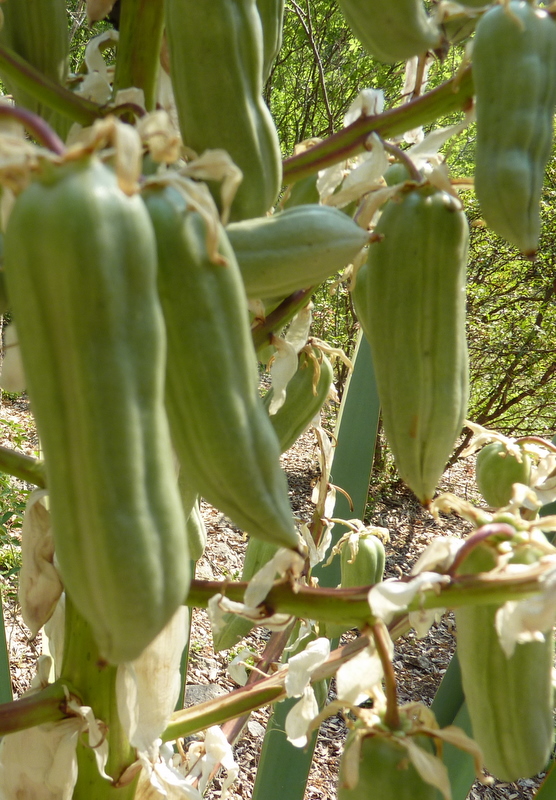
Seed pods quickly replacing white yucca flowers

The first of yellow prickly pear cacti flowers.  Near the top of Whitman's Rough.


These are the beautifully eroded limestone boulders at the top of the hill.
     Carbon dioxide in the air turns into carbonic acid after it dissolves in rain water.  And because limestone is basic, the acid in the water can create such other-worldly shapes as these.  When the rain water settles onto one spot of boulder and is allowed to chew away at stone, it can form flat pools like the one above.  For limestone like this to be dissolved, the following sequence of reactions takes place:


H2O + CO2 → H2CO3
CaCO3 → Ca2+ + CO32–
CO32– + H2CO3 → 2 HCO3
CaCO3 + H2CO3 → Ca2+ + 2 HCO3


Mustang Grapes (Vitis mustangensis) just beginning to fill out. These vines are sprawling 
out on top of short walnut trees out in The Stone Field near The Creek.
Turkey vulture riding thermal lifts above the sandstone bluff.


Trees Falling in a Forest

     Yes, they do fall.  And they make a noise.  The ones we wish we had seen, and the ones we don't yet know we want to see.  There's just no way to soften the hard fact that beauty and grace and light and the reddest feathers you could ever wait to see all happen behind our backs and without the slightest apology for the show that goes on second by second even now as you and I focus merely on the end of this sentence.
     Carol just spoke with me on the phone about the pair of summer tanagers she saw today.  In the Live Oak. While I was at work on the ambulance.  Six point three miles away.  Behind my back.


Piranga cooperi
(Courtesyanimals.nationalgeographic.com)


     She said she saw both the adult male and the female, both flitting among the branches and sounding the same.      


     She and I compete each year to see who can identify the first this or that bird.  Usually the scissor-tailed flycatcher, the kestrel, and the painted bunting.  But any spotting can provide opportunity.


      More lovelies flowering, whether we see them or not.  (Harlin saw these.)
Cutleaf evening primrose (Oenothera laciniata)

Rock Lettuce, or White Dandelion (Pinaropappus roseus)


Verbena


Nightshade (Solanum triquetrum)


Wild Garlic


Bitterweed  (Hymenoxys scaposa)

Water-Willow in Time of Drought

"Water Willow"
Dante Gabrie Rossetti (1871)

     So, sometimes a lovely little painting just doesn't cut it.  Honesty trumps snobbery and pretension.  I do enjoy, however, the boat in the background.  Boats are good.
     But this afternoon I returned after several days' absence to The Creek to hose down the orchard and blackberry vines.  In the mean time, that gorgeous and abundantly growing plant along the southern edge of the pond and beside much of the upper section of creek had  bloomed (see blog entry on reasons for depression).  Without warning and without waiting for me to pull up a stone seat to watch, sweet white and purple blossoms on slender four-inch spikes had bloomed all across the deep green swatch of Justicia americana.

Justicia americana (American water-willow)

Justicia americana (L.) Vahl

American water-willow, Water-willow

Acanthaceae (Acanthus Family)

[photo credit: UT's Native Plant Database  http://www.wildflower.org]
     
     Here is a less than spectacular image (Android phone standing in) of water-willow growing on the southern end of The Pond.


     Before we completely demolished the double-wide trailer up the slope from the pond, we dug up two old rose bushes under its front door and transplanted them over beside the orchard and berries.  Now they're thriving nicely, to the great satisfaction of the leaf-cutter bee.  Below is an example of her handiwork I saw and photographed today:
     Of the family Megachilidae, this very small bee that resembles more a housefly, seems to prefer rose leaves as the material with which it will line a buried hole and into which it will lay eggs.  I first watched this insect ten years ago.  Seems I had never noticed cuttings out of leaves like this before, but now I see them everywhere. 

File:LeafCutterLyd.png


crepuscular


Plenty of  animals become more active during the twilight of dawn and dusk (plants do too if we count such flowers as the yellow evening primrose that opens its flower about the time we lose our sun over Whitman’s Rough).  Mountain lions are more active then.  I am not.
But I do regard these times as sacred, and I’d like to think that’s the reason for my increased inactivity at dawn and dusk.
When we are down in the little canyon, we don’t get early morning or evening sunrises or sunsets.  We get their echo, though.
            The eastern wall of sandstone bluff, juniper, mesquite, and cedar elm the other side of the creek reflects the sunset we cannot see, and the limestone and oak hillside west of the homesite reflects the sunrise we cannot see.  These rocky bluffs relay for us the story of our sun’s activity near the distant horizons. 
            The echo of light means that we see direct sunrise light and sunset light a small bit of time later than the actual event, same as an echo sounds out a story that is already history.  But at 180,000 miles per second, and with the distance from the Great Live Oak to either bluff being about one eighth of a mile, who’s counting?  (744,000th of a second late—that’s about how long after the original sunlight passing horizontally over our heads takes to reach the eastern bluff and ricochet to the back wall of our eyes.)
            Twilight.  We learn there is such a thing as “civil twilight” (that period of time in the morning or the evening when the sun is no more than six degrees below the horizon), “nautical twilight” (when the sun is between six and twelve degrees below the horizon and the horizon itself is no longer visibly defined), and “astronomical twilight” (when the sun is between twelve and eighteen degrees below the horizon and the light of the sun no longer contributes to the illumination of the sky).  So if actual sunset occurs at 7:56 p.m., for instance, then civil twilight happens at 8:21 p.m., nautical twilight at 8:50, and astronomical twilight at 9:19.  (Whoever said beautiful things couldn’t be measured probably meant that the thing and its beauty are separate things, a rather silly notion.  As if a thing can exist without any description.)

            And we continue to measure the level of the pond as it falls daily during this drought.  During the second week of February I pounded in a short rod into a dark gray mud.  At that time, the skin of the pond touched about six inches above the mud in the southern shallow end.  Two days ago, the top of the pond touched dry land about six feet away from the measuring rod.  So the fluctuating level of a body of water can be measured by a vertical rod, either in the rising and falling of waters’ top up and down the rod, or in the waters’ retreat from the entire rod itself.  Last night we received the first rains in a very long time.
            But we continue to measure just about everything out at The Creek, including the depth of life we experience.  That is measured by the heightened sense of awareness.  And awareness does not come automatically.  You begin by watching yourself see what surrounds you.  This self-awareness quickly gives way to the Other, whether it’s the wavy fossil remains of an ancient sea plant or the dusty stamen of a hidden flower or the white bone-flakes that comprise the matrix of a large mammal’s desiccated scat.  You rise early in the day to find that the Other has never been asleep, and you linger in the dusky end of day until you lose sight of any details but the blinking taillight of a mating firefly and the steadier white light of a distant galaxy both of which shine upon the open eye or the closed eye with equal concern but with quite unequal effect. 
It’s that effect that stills something within us during the opening and the closing of the day, and so we become less active and more alive.

The official time of sunset on the day of these photos was 7:56 p.m.  At 7:20 p.m. the first of the photos was taken.  We'll try to get some better photographs of this transition.  On this evening, the western sky was too hazy with oak pollen and west Texas dust and ash from grass fires. 

Shadow-rise:  7:20 p.m. 

Shadow-rise: 7:25 p.m. 

Shadow-rise: 7:30 p.m. 

Among the Pueblo Indians of the American Southwest, the chief of the pueblo was often known as the cacique, and it was this religious man's job to watch the sun.  He might position himself on a top adobe home well before astronomical twilight in the morning and late into the night at the other end of the day.  He could watch the sun rise between two distant mesas or set over a lone piñon pine and know the day of the year or the time for planting or holding a ceremony.  He was clock, calendar, chief, priest, and eye of the people. 


 Guaicaipuro, a celebrated cacique.