Early Autumn's Warm Gold


Just entering the place

Fox scat?

Cedar Elm

Sumac

One of 300-350 species of Smilax.  This one hanging
within a gum bumelia tree (Bumelia lanuginosa)
.


A second blooming for this Malvaceae near the front gate. 


Texas Spiny Lizard (Sceloporus olivaceus) on Limestone


     Another crappy video and even crappier audio of an osprey (Pandion haliaetus).  We were standing  out front of the Hog Shed when we first heard this one screaming high, high just off to the north.  He (or she) would dive down a ways, pause-up, and then dive down again, never really laying off the horn.  Five minutes later we noticed a second osprey rise up from perching on a tree along the boulders north of the house.  This one made the chirping rather than screaming call.  We haven't seen nor heard of the ospreys since last early spring, I think it was.  This is good.
     Where these have flown in from is anybody's guess, but typical migratory patterns might suggest they have just come down from the Rockies.
     Below is an interesting map showing the travels of three ospreys tagged in the Grand Tetons.  The red lines represent their flights down south, and the blue lines represent the trip back to the Tetons.  One of the three birds flew past our area of central Texas to the coast but never made the return trip.


First Week of November (Part 2)

And now for some of Harlin's photographic work to help us see the Creek's riparian beauties and intricacies about this time of year. . . .


Curlytop Gumweed  (Grindelia nuda)

Curlytop Gumweed  (Grindelia nuda)

Clammyweed (Polanisia dodecandra)

Clammyweed (Polanisia dodecandra)

Wild Poinsettia or Toothed Spurge (Euphorbia dentata)

Goldenrod with flood debris

Senna


Product description
Senna (from Arabic sanā), the sennas, is a large genus of around 250 species of flowering plants in the family Fabaceae. Sennas are still used as the primary ingredient in certain commercial stimulant laxatives. Senna is also the primary ingredient found in most "dieter's teas".


And some distant sandhill cranes circling their way south over The Creek.

First Week of November (Part 1)

     The four and a quarter inches of rain we had weeks ago has sustained the grasses, enlivened the Creek, introduced a completely new population of fish to the Pool, and given the courage of bloom to flowers meant to bloom now as well as to flowers not normally in blossom (Mexican buckeye among the boulders of Whitman's Rough, for instance).  No water flows above ground from the Pond to the Creek, but the water emerges from its usual spot and takes only a few feet before it's running clear and lively.


Chaste tree (*see note at bottom)

Poverty Weed (Baccharis neglecta)
Also known as Roosevelt Weed or New Deal Weed, this Baccharis grows just east of the south end of the Pond and near the sandy bank of the Bluff.  It's one of those native plants that looks like a non-native invasive species, quickly adopting any disturbed  or otherwise sorry soils that many other plants cannot survive in.  Right now it's in bloom, as it often is following late-summer rains.  After the Dust Bowl era, it was planted to help revegitate waste areas.


Jaw-dropping excitement with switchgrass.

...and with palafoxia in the wind.  Who knew?


*Here below is a copy-and-paste job from the Internet's interesting-to-know category with plenty of ideas about the medicinal uses of the chaste tree.  To cut to the chase, this plant has been used to treat both female infertility AND the occasional overactive libido of monks.  Whether or not there is any relationship between these two indications is your happy guess.


Chaste Tree Berry : The People's Pharmacy®

October 18, 2005   http://www.peoplespharmacy.com/2005/10/18/chaste-tree-berry/

Chaste tree is a large shrub (up to twenty-two feet tall) native to the Mediterranean and southern Europe. Although it flourishes on moist riverbanks, it is easily grown as an ornamental plant in American gardens, where its attractive blue-violet flowers are appreciated in midsummer.
The Greeks and Romans used this plant to encourage chastity and thought of it as capable of warding off evil.
Medieval monks were said to use the dried berries in their food to reduce sexual desire. As a result, it was also referred to as "monks' pepper."
Although Hippocrates used chaste tree for injuries and inflammation, several centuries later Dioscorides recommended it specifically for inflammation of the womb and also used it to encourage milk flow shortly after birth.
Current use of chasteberry is almost exclusively for disorders of the female reproductive system.
Oddly, the conditions for which it is most commonly recommended, premenstrual syndrome (PMS) and peri- or postmenopausal symptoms such as hot flashes, are associated with completely different hormone imbalances.
Two authors publishing the results of a survey of medical herbalists were led by this observation to suggest that chaste tree should be considered an adaptogen, possibly affecting the pituitary gland.
Usually the dried berries are the part of the plant used. In some Mediterranean countries, leaves and flowering tops are also harvested and dried for use.
Active Ingredients
No one constituent of chaste tree has been isolated as responsible for its medicinal effects.
The berries contain iridoids as glycosides, including aucubin and agnuside.
Flavonoid content is highest in the leaves (up to 2.7 percent) and flowers (nearly 1.5 percent).
The berries contain almost 1 percent of flavonoids such as casticin, isovitexin, orientin, kaempferol, and quercetagetin.
It is perhaps surprising that chaste tree does not contain plant estrogens. Instead, progesterone, hydroxyprogesterone, testosterone, epitestosterone, and androstenedione have been identified in the leaves and flowers.
The essential oil of chasteberry may be responsible for its distinctive spicy aroma. It contains monoterpenes cineol and pinene, along with limonene, eucalptol, myrcene, linalool, castine, citronellol, and others, plus several sesquiterpenes.
An alkaloid, vitricine, is also an ingredient.
Uses
Animal research has shown that extracts of chaste tree berry have an effect on the pituitary gland of rats, reducing prolactin secretion. This has the impact of reducing milk production, exactly the opposite effect suggested by some of the ancient texts.
As a result of these studies, chaste tree has been suggested to treat conditions associated with excess prolactin. In a clinical trial of chasteberry for menstrual cycle abnormalities attributed to too much prolactin, the herb normalized both the cycle and the levels of prolactin and progesterone hormones.
It is also believed helpful for premenstrual breast tenderness, a condition linked to excess prolactin.
Several uncontrolled studies in Germany have shown that chaste tree extracts can reduce symp-toms associated with PMS. In one of these studies, the investigators reported higher blood levels of progesterone as a result of treatment.
If chaste tree can normalize hormone levels, it may be helpful for perimenopausal women with unusually short cycles or heavy bleeding. Dr. Susan Love considers that it may be worth a try.
No clinical studies to date have determined the effectiveness of chasteberry for menopausal symptoms, but many medical herbalists in the United Kingdom use it to treat hot flashes.
These practitioners also prescribe it for female infertility, but there are no data to indicate if chaste tree is helpful for this problem.
Although studies are lacking, the antiandrogenic effect of chaste tree berry is the rationale behind the use of this herb to treat acne in both men and women and its very occasional use to reduce an overactive libido.
Dose
The usual dose is 20 to 40 mg of the herb, or its equivalent.
If using a tincture, take 20 drops one or two times a day. Capsules or tea (one cup) may be used instead if it is more convenient.
Taking chasteberry shortly before bedtime may increase early morning melatonin secretion and improve sleep.
Chaste tree berry is slow acting. Two or three menstrual cycles, or a similar amount of time, may be needed to evaluate the effects.
A standardized product from Germany is available in the United States under the brand name Femaprin.
Special Precautions
Pregnant women should not take chaste tree berry.
Although one study indicated that this herb does not affect the composition of breast milk, nursing mothers are advised to avoid it. Despite its traditional use to increase milk production, the likelihood that the herb suppresses prolactin could make nursing more difficult.
Herbal practitioners may recommend that chaste tree berry not be used by women with hormone-sensitive cancers (breast, uterus). Anyone with such a serious condition should certainly be consulting an expert for advice before self-treating with any herb. Pituitary tumors also come into this category.
Adverse Effects
Side effects are uncommon, but itchy allergic rashes have been reported.
A few patients may experience mild nausea or headaches, especially when starting treatment.
A few women have complained that the length of their cycle changed, and in rare cases women experience heavier menstrual periods.
Possible Interactions
In general, chaste tree berry should not be combined with exogenous hormones such as oral contraceptives or menopausal hormone replacement therapies (Premarin, Prempro, Premphase, Provera, etc.).
Animal experiments indicate that compounds that act on dopamine in the brain may affect or be affected by the herb. Such drugs include Haldol, a medication for psychosis, L-Dopa or Parlodel for Parkinson's disease, Wellbutrin for depression, or Zyban for quitting smoking.
No clinical consequences of interactions have been reported.

Waters Again


Creek and Pool back in business

Logperch (Percina caprodes)

     Within the Creek upstream of the Pool, we sat on cool stones and watched as several logperch  fed along the sandy bed of the stream.  They turn the pieces of gravel, feeding on such small animals as rotifers and waterfleas.  The stone-turning behavior is one of the best ways to identify this species.   As they grow older, the logperch will feed on such things as leeches, fish eggs, snails, and insect larvae.  Like other darters, this non-schooling fish lives alone or in the presence of only a few others.  
      As for breeding, the female will lay eggs within the gravel bed after the male and her have briefly joined up.  But the fertilized and hatched young ones will be left to themselves.  One source sums up the family-values of the logperch: "Beyond laying and fertilizing eggs, logperch exhibit no parental investment." 
     In the accompanying video below, we hear observers commenting on some nearby dragonflies' sex-life.  Below are comments regarding the sex-life of logperch: 

      "Spawning season: In Central Texas, mid-December or early January to mid-May (Hubbs 1985); average seasonal temperature in Central Texas at the time females are known to be ripe varies from 9-23 degrees C (Hubbs and Strawn 1963). Spawning habitat: Over sand or gravel-bottomed areas of streams or in sand shoal areas of lakes (Winn 1985a); brood hiders that release eggs just below the surface of the substrate; lithophils, rock and gravel spawners that do not guard their eggs (Simon 1999).

     Spawning behavior: In lakes, breeding males are non-territorial and weakly so in streams, defending only the immediate area around a female (referred to as moving territory; Ross 2001).  Male mounts female just prior to spawning, placing his pelvic fins in ahead of hers, bending his tail down alongside her tail. Both fish quiver, raising a cloud of sand as they partially bury themselves. During this time, eggs laid and fertilized. Exposed eggs are usually eaten by other males. On occasion, female may vibrate and partially bury herself before being mounted by male (Winn 1958a).
     Fecundity: Egg counts varies from 1,060-3,085 for mature females of sizes ranging 55-84 mm SL (ova count averaged about 2,000 in two-year-olds); however only 10-20 eggs are laid at each spawning. Larger females produce more eggs than do smaller females (Winn 1958a). Average diameter of mature, ovarian eggs is 1.31 mm; eggs colorless and transparent (Winn 1958b). Cooper (1978) recorded eggs, each with granular yolk, numerous small oil droplets, and one large oil droplet, that averaged 1.1-1.3 mm in diameter, and hatched in about 200 hours after fertilization at an average water temperature of 16.5 degrees C. Grizzle and Curd (1978) reported egg hatching occurring in 5-7 days at water temperatures of 21-23 degrees C."

     Their name Percina means “a small perch,” and caprodes is Greek for “resembling a pig,” in reference to the snout.


Focusing on the shale bed underlying the Creek.

Still focusing on the underlying bed of shale beneath a scene of dragonfly intimacy.

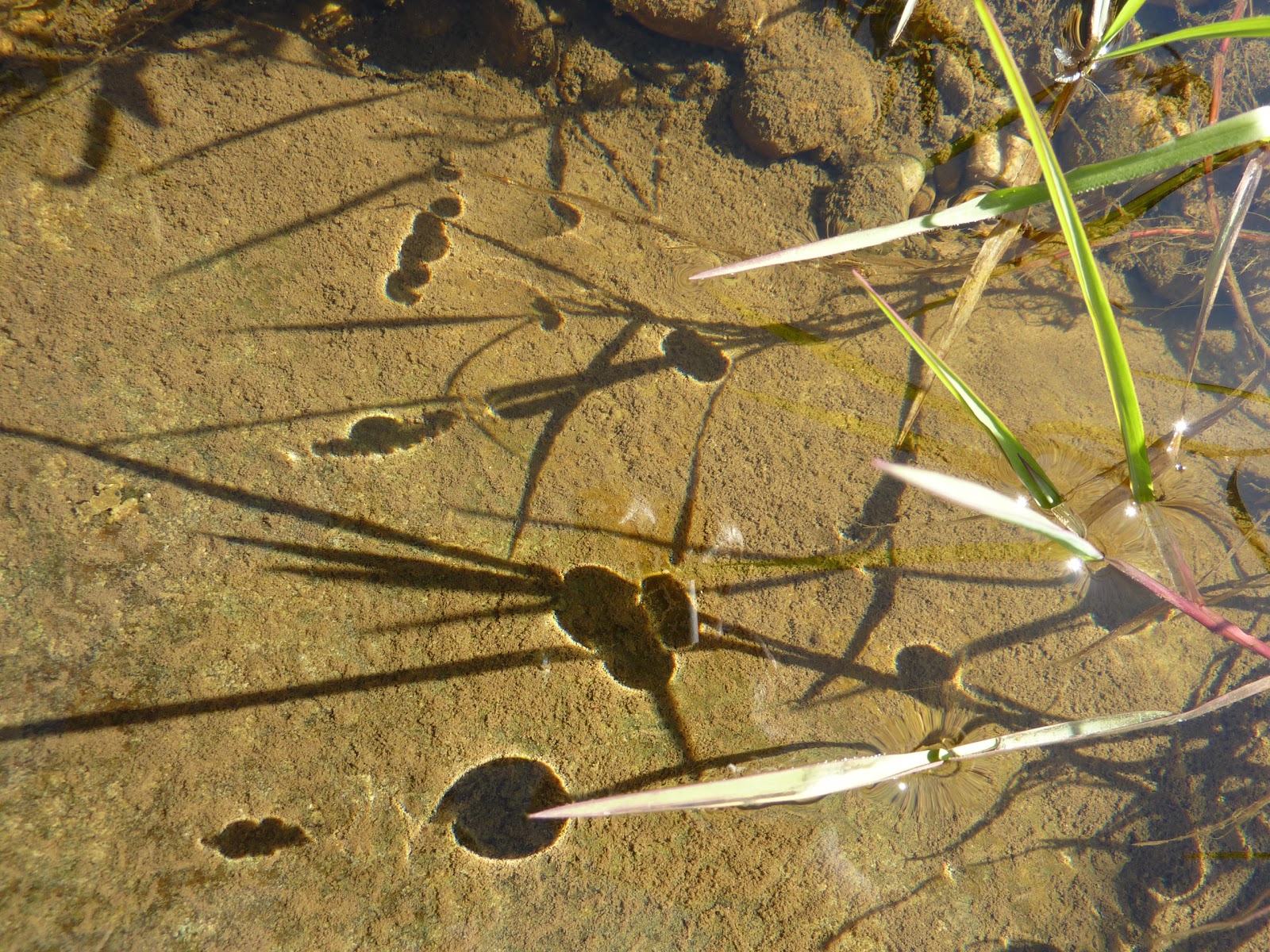
Dimple-shadows rhythmically passing over creek-stones.

Curved stream-ripples

Rain-Lily (Cooperia drummondii)
     The specimen of Cooperia above is probably drummondii rather than  pedunculata because of the season.  Pedunculata blooms in the spring and drummondii in September and October.  Additionally, pedunculata has a floral tube that is 1-1 1/2 inches long, and the floral tube of drummondii is 3-7 inches long.


June 2007 debris 
     Fluvial geomorphologists study how processes associated with rivers and streams change the shape of the earth.  So one of the things they study is debris.  I could do that.  In the photo above we see fairly large pieces of debris caught in a big tree on the lower south end of the property.  But it's not technically big enough to be called "large woody debris (LWB)."  There's actually a term for that (skeptics may be referred to the 2003 article in the journal Geomorphology, volume 51, pages 61-80 for an example). LWB must be at least 10cm in diameter, and our piece in the center of the photo is but half that.  But the piece does show interesting evidence of having been chewed on by nutria or beaver.

Diggings of armadillo or feral pig?
     The photo above shows evidence of either an armadillo taking advantage of moist and softened soil, or it's from a feral pig.  I haven't seen any of the pigs in this valley, but they are all over the southern part of the county, the other side of Hwy 71 and then just down RR 1431 about eight miles and then down along the Colorado along Shaffer Bend.  However, two mornings ago when we were driving our Ambulance back RR 1431 from Round Rock, I saw what looked like a dead hog on the side of the road just a few miles east of Marble Falls.  It's probably only a matter of time before the animals find this stretch of Creek and the little orchard up the bank.


We've looked at this sort of (acidic?) erosion on the limestone up among
 boulders on Whitman's Rough, but I can't get enough of the beautiful forms.

Harlin excogitating creekside.


Finally

     I really don't know what to say about four and a quarter inches of rain during a drought dry enough to stop a stream.  But when I opened the door of the pickup this afternoon, the sound of water on rocks changed all my plans for the rest of the day.

The muddy Pond

The water-gauge caught the full force if current and debris.
When these leaves were pushed aside, the water level was seen
to be exactly what it was the first day it was driven into pond-mud. 

At first I couldn't believe that debris six feet up in these sycamores
could possibly have been from this weekend's flood.

But it was.  Here we have fresh debris at head-level twenty feet from the streamside.
The level of the Creek must have been higher by close
 to ten feet or so.  Four and a quarter inches means ten feet or more.

The Pool is up.  What happened to fish remains to be seen.


A slow walk with Walter to inspect the wonderful  changes.


This is how my dried out brain interpreted the joyous
 site of a little water in a little canyon.