In a January Month


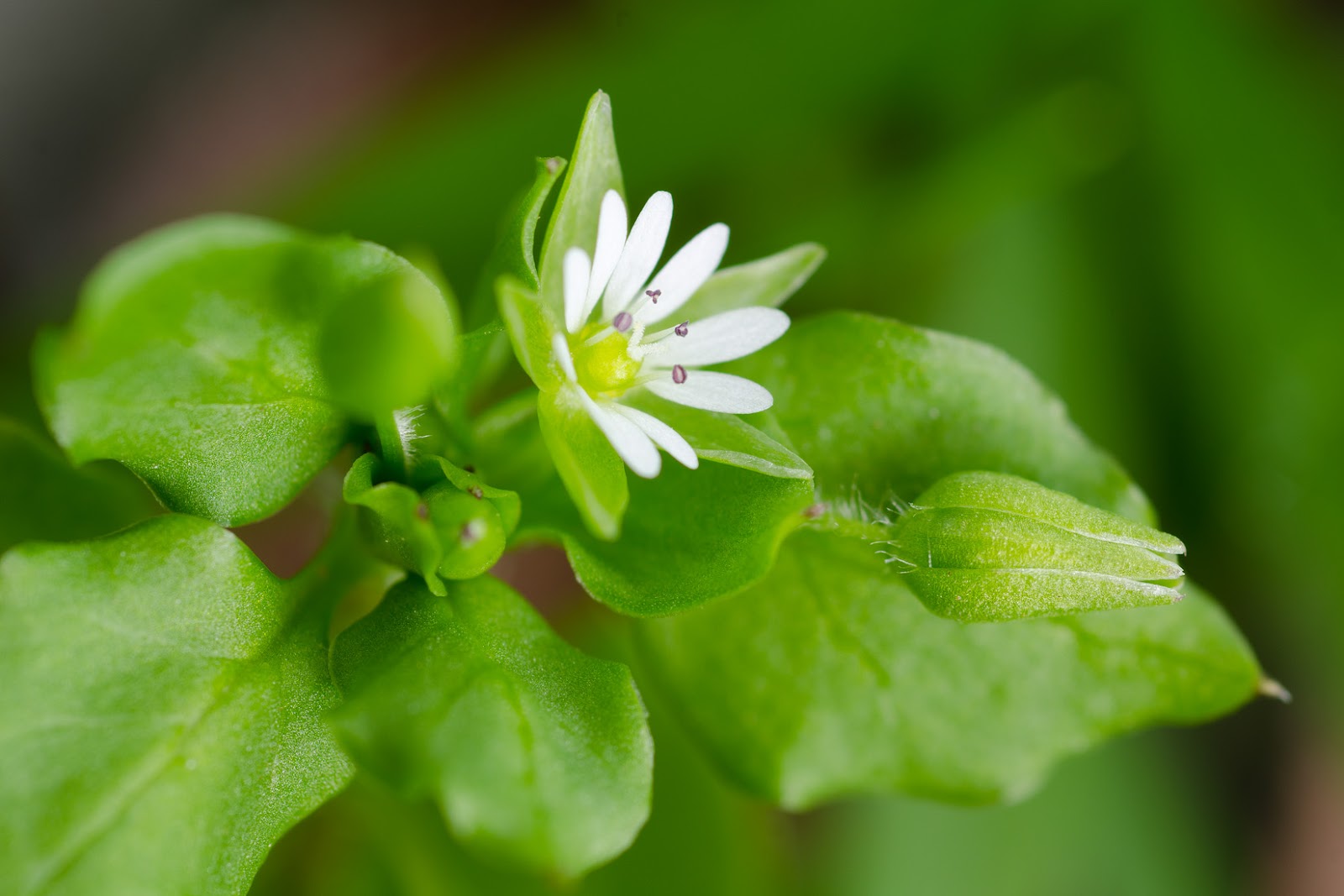
Chickweed (Stellaria)

Chickweed (Stellaria)


Chickweed Jr. Spaghetti Tank
$27.99


The Wildman who promotes all things Chickweed (from women's tanktops to pots of the steamed yard weed) offers this advice on preparing the plant to eat:

FOOD USES: Chop common and star chickweed, and add them, raw, to salads, or cook them like spinach. Mouse-ear chickweedís so hairy, you have to cook it.
Chickweed gets its common name because chickens love it. Raw, it tastes like corn silk. I demonstrate this to school kids with a chicken imitation, then I grab the herb from the teacher's hand with my teeth and swallow it—corny, but consistent with the plant's flavor!
Cooked, chickweed tastes like spinach. Include any of the species in soups and stews, but cook no more than 5 minutes to prevent overcooking. Unlike most other edibles, the stems, as well as the leaves and flowers, taste good.
Cooking shrinks chickweed by 3/4, concentrating the nutrients and compensating for whatever vitamins cooking destroys.


Henbit (Lamium amplexicaule)

Henbit (Lamium amplexicaule)

Mistletoe (Phoradendron tomentosum) 


Pilobolus left on a pile of dung from an errant cow that strayed onto the place this month.


Please watch this video for the little fungus in action.


Stinging Nettle or Heart-Leaf Nettle (Urtica chamaedryoides)

Urticaria flowering


Persian Speedwell  (Veronica persica)

 Burclover (Medicago minima)


Pennsylvania pellitory (Parietaria pensylvanica) 


Parietaria pensylvanica or Pennsylvania pellitory.  At this time of year (when it rains enough) it makes soft green clumps all around the fallen branches and the rocks.  Harlin included a picture of the slope (there is a clump behind the rock on the lower right of the photo) and a picture of the leaves.  The plant is wind pollinated and some species have been found to cause an allergic reaction.  So, if you lay on the rocks in your backyard and find you are wheezing, maybe it’s the pellitory.  [Science News, Vol. 137, No. 19 (May 12, 1990), p. 300]


Some of the algae in abundance this season.

Phoradendron tomentosum as the only color
in a rather foggy little canyon

A friend brought us this specimin of Horse Crippler (Echinocactus texensis).
Thank you, Lee.


Thank you, Kate.

An unidentified fruticose lichen among cedar elm leaves littering Whitman's Rough.


January 24 and 25 the rains fell again.  Perhaps three inches.

A nice discussion on a warm January 7 afternoon beside the Creek.


High on a cool and windy January 28.  High.

Gold, Gar, and Geology


Wok


Texas Gold Rush
by Mike Cox

Only four years after thousands of Forty-niners flocked to California in search of riches, a wave of Fifty-threers headed for the Hill Country in a little known and short-lived Texas gold rush.

Word of potential wealth in newly created Burnet County spread across the nation as fast as sailing ships could make it from Indianola and Galveston to New York with Texas newspapers.

“Important from Texas – The Gold Discoveries Confirmed—Great Excitement,” read a one-column headline in the April 20, 1853 edition of the New York Times. That report had been abbreviated from the New Orleans Picayune of April 18. According to the item:

“The news fully confirms the previous reports received of rich discoveries of gold on the Upper Colorado River, and also above Austin. Large amounts had already been collected by those who proceeded to the ‘diggins,’ and the greatest excitement prevailed throughout all Texas.”

Of course, the shining belief that gold – and silver – could be found in the Hill Country dated back to Spanish Texas. Later, colonizer Stephen F. Austin bought into the idea, as did the adventurous scalawag Jim Bowie. While his dreams of wealth ended at the Alamo, the notion persisted that the mineral-rich hills north and west of Austin held untold riches. And for a few months in 1853, it looked like Texas would be the new California.

A week after its first report, the Times offered its readers more details on the Texas bonanza. Reprinting a story from the April 15 Galveston News, the New York newspaper said:

“The steamer James L. Day arrived this morning from Aransas and Matagorda Bays. The most important item of news is the discovery of gold mines in Hamilton’s Valley, above Austin. We have heard rumors of these mines by gentlemen from the interior, but we had occular proof of their existence in a specimen which Captain Talbot exhibited to us this morning. It is a piece of quartz rock, a little larger than a common-sized marble, with pieces of bright gold attached to it. The color of the gold is much clearer than California specimens.”

The newspaper went on to report that “rumors are rife of large quantities of gold being found throughout the western portion of [Texas]” with “great excitement prevailing at Austin, San Antonio, Seguin, Gonzales and other points.” Indeed, several "companies" (used in the 19th century as a synonym for "parties" or "groups") were organized and en route to search for gold.

Though longer, this story offered no further detail on the location of the reported gold find other than in Hamilton’s Valley “and various other places.” Still, the final information in the story doubtless contained all the information seekers of wealth needed to read: “One person sold a piece of quartz in San Antonio for $25.” Back then, $25 had the purchasing power of $780 today.

A month later, the Texas gold rush continued to make national news.

“The latest news from Texas will excite all those who desire to make money in any other than the natural way—by hard work of the hands and brain,” began a piece in the Alton, Ill. Weekly Courier of May 20, 1853. The Illinois newspaper went on to reprint an item from the Lavaca Commercial (a long-extinct Port Lavaca sheet) that actually offered some detail on Texas’ new-born mining district.

“There are now from 300 to 400 persons at work in the mines, and we learn that they are averaging from $5 to $10 per day each, and some few of them have already succeeded in gathering as much as $1,500 to $2,000 worth of gold.”

Austin’s Texas State Gazette weighed in with a report that up to 500 people were hard at work digging for gold “in our neighborhood,” including one operator who in two days “obtained $500 worth of gold.” Noting that the gold play was “easy of access from this city,” the newspaper continued that “we shall not be surprised to hear soon of discoveries equalling in importance the golden stories of California.”

On July 3, 1853 Burnet County pioneer Logan Vandeveer, a Kentuckian who had fought in the Texas Revolution, wrote his father that there was “some excitement in this country about gold mines and other minerals.” He continued: “I cannot see how it will turn out. The people come here in great quantities. Some of them return and some and others remain. It could be the means of selling this country.”

Despite all the hoopla, at least one out-of-state newspaper editor had his doubts about the purported gold discoveries in Texas.

“This reads very much like a hum,” the Milwaukee’s Weekly Wisconsan had observed on May 18. By “hum,” the writer meant humbug, as in hoax or fraud.

Alas, even if all that glitters IS gold, that particular precious metal has to be available in real plentitude to sustain a boom. While some apparently did find some gold, by summer of that year reports concerning the great Texas gold fields had disappeared from the newspapers.

Though the Hill Country did not prove to be the new El Dorado, gold has been and can be found in the beds of various streams feeding into the Colorado above Austin, including Hamilton Creek in Burnet County. But while geologists have long since concluded that the mineral-rich region (with Llano County being the epicenter) does have gold deposits, it does not exist in commercial quantity.

Still, with the current price of gold being $1,400-plus an ounce…. 

© Mike Cox - 
July 14, 2011 column

http://www.texasescapes.com/MikeCoxTexasTales/Texas-Gold-Rush.htm


Spotted Gar (Lepisosteus oculatus)

     Spotted gar.  I think.  The images here are difficult to work with, and the camouflage is admirable, but it's certainly not an alligator gar, and about the only other option is a longnose gar which actually has about as long of a nose as that of the spotted gar and lacks the brown skin and spots of the latter. This one was slowly moving around on the bottom of the pool.  After our four-inch rain awhile back, all the bluegill and other fish we had come to know down in the pool were washed out and exchanged for this single gar, a medium-sized carp, and three odd light-colored fish that circle in a slow triangle nose-to-tail for hours on end.

Spotted Gar (Lepisosteus oculatus)


Harlin's find during his gold panning experience


Water willow
     The Creek remains at its normal level of water flowing out of a Pond that's resting at its own normal level, several inches up the water-meter stick.  
     I am tempted to intervene and "restore" the Creek and its environs to what I imagine to be their natural state.  In other words, if a small juniper or sycamore lies bent because of a flood's current, then I want to right the tree.  If debris hangs from a limb, I want to remove it.  If fish have been washed out of the Pool, I want to restore them.  If a plant died in the drought, I want to yank it out of the ground.  But restoration to what?  Drought and flood have shaped this valley, these hills, and everything about this creek.  
     So I pull my thoughts back to what "natural" means in the context of a world of flux.  If I have to look at a brown and then a gray juniper for the remainder of my days, then I will still be looking at nature as much as if I had replaced it with a green tree.  
     Everything is in flux; everything is graying; everything is shifting, silting, piling up, wearing down, eroding, breaking, going away, and coming to.  Now we will make room for such an appreciation.


Window trim going up.  Siding next.

Tongue-and-groove No. 2 yellow pine for the ceiling.


Early Autumn's Warm Gold


Just entering the place

Fox scat?

Cedar Elm

Sumac

One of 300-350 species of Smilax.  This one hanging
within a gum bumelia tree (Bumelia lanuginosa)
.


A second blooming for this Malvaceae near the front gate. 


Texas Spiny Lizard (Sceloporus olivaceus) on Limestone


     Another crappy video and even crappier audio of an osprey (Pandion haliaetus).  We were standing  out front of the Hog Shed when we first heard this one screaming high, high just off to the north.  He (or she) would dive down a ways, pause-up, and then dive down again, never really laying off the horn.  Five minutes later we noticed a second osprey rise up from perching on a tree along the boulders north of the house.  This one made the chirping rather than screaming call.  We haven't seen nor heard of the ospreys since last early spring, I think it was.  This is good.
     Where these have flown in from is anybody's guess, but typical migratory patterns might suggest they have just come down from the Rockies.
     Below is an interesting map showing the travels of three ospreys tagged in the Grand Tetons.  The red lines represent their flights down south, and the blue lines represent the trip back to the Tetons.  One of the three birds flew past our area of central Texas to the coast but never made the return trip.


First Week of November (Part 2)

And now for some of Harlin's photographic work to help us see the Creek's riparian beauties and intricacies about this time of year. . . .


Curlytop Gumweed  (Grindelia nuda)

Curlytop Gumweed  (Grindelia nuda)

Clammyweed (Polanisia dodecandra)

Clammyweed (Polanisia dodecandra)

Wild Poinsettia or Toothed Spurge (Euphorbia dentata)

Goldenrod with flood debris

Senna


Product description
Senna (from Arabic sanā), the sennas, is a large genus of around 250 species of flowering plants in the family Fabaceae. Sennas are still used as the primary ingredient in certain commercial stimulant laxatives. Senna is also the primary ingredient found in most "dieter's teas".


And some distant sandhill cranes circling their way south over The Creek.

First Week of November (Part 1)

     The four and a quarter inches of rain we had weeks ago has sustained the grasses, enlivened the Creek, introduced a completely new population of fish to the Pool, and given the courage of bloom to flowers meant to bloom now as well as to flowers not normally in blossom (Mexican buckeye among the boulders of Whitman's Rough, for instance).  No water flows above ground from the Pond to the Creek, but the water emerges from its usual spot and takes only a few feet before it's running clear and lively.


Chaste tree (*see note at bottom)

Poverty Weed (Baccharis neglecta)
Also known as Roosevelt Weed or New Deal Weed, this Baccharis grows just east of the south end of the Pond and near the sandy bank of the Bluff.  It's one of those native plants that looks like a non-native invasive species, quickly adopting any disturbed  or otherwise sorry soils that many other plants cannot survive in.  Right now it's in bloom, as it often is following late-summer rains.  After the Dust Bowl era, it was planted to help revegitate waste areas.


Jaw-dropping excitement with switchgrass.

...and with palafoxia in the wind.  Who knew?


*Here below is a copy-and-paste job from the Internet's interesting-to-know category with plenty of ideas about the medicinal uses of the chaste tree.  To cut to the chase, this plant has been used to treat both female infertility AND the occasional overactive libido of monks.  Whether or not there is any relationship between these two indications is your happy guess.


Chaste Tree Berry : The People's Pharmacy®

October 18, 2005   http://www.peoplespharmacy.com/2005/10/18/chaste-tree-berry/

Chaste tree is a large shrub (up to twenty-two feet tall) native to the Mediterranean and southern Europe. Although it flourishes on moist riverbanks, it is easily grown as an ornamental plant in American gardens, where its attractive blue-violet flowers are appreciated in midsummer.
The Greeks and Romans used this plant to encourage chastity and thought of it as capable of warding off evil.
Medieval monks were said to use the dried berries in their food to reduce sexual desire. As a result, it was also referred to as "monks' pepper."
Although Hippocrates used chaste tree for injuries and inflammation, several centuries later Dioscorides recommended it specifically for inflammation of the womb and also used it to encourage milk flow shortly after birth.
Current use of chasteberry is almost exclusively for disorders of the female reproductive system.
Oddly, the conditions for which it is most commonly recommended, premenstrual syndrome (PMS) and peri- or postmenopausal symptoms such as hot flashes, are associated with completely different hormone imbalances.
Two authors publishing the results of a survey of medical herbalists were led by this observation to suggest that chaste tree should be considered an adaptogen, possibly affecting the pituitary gland.
Usually the dried berries are the part of the plant used. In some Mediterranean countries, leaves and flowering tops are also harvested and dried for use.
Active Ingredients
No one constituent of chaste tree has been isolated as responsible for its medicinal effects.
The berries contain iridoids as glycosides, including aucubin and agnuside.
Flavonoid content is highest in the leaves (up to 2.7 percent) and flowers (nearly 1.5 percent).
The berries contain almost 1 percent of flavonoids such as casticin, isovitexin, orientin, kaempferol, and quercetagetin.
It is perhaps surprising that chaste tree does not contain plant estrogens. Instead, progesterone, hydroxyprogesterone, testosterone, epitestosterone, and androstenedione have been identified in the leaves and flowers.
The essential oil of chasteberry may be responsible for its distinctive spicy aroma. It contains monoterpenes cineol and pinene, along with limonene, eucalptol, myrcene, linalool, castine, citronellol, and others, plus several sesquiterpenes.
An alkaloid, vitricine, is also an ingredient.
Uses
Animal research has shown that extracts of chaste tree berry have an effect on the pituitary gland of rats, reducing prolactin secretion. This has the impact of reducing milk production, exactly the opposite effect suggested by some of the ancient texts.
As a result of these studies, chaste tree has been suggested to treat conditions associated with excess prolactin. In a clinical trial of chasteberry for menstrual cycle abnormalities attributed to too much prolactin, the herb normalized both the cycle and the levels of prolactin and progesterone hormones.
It is also believed helpful for premenstrual breast tenderness, a condition linked to excess prolactin.
Several uncontrolled studies in Germany have shown that chaste tree extracts can reduce symp-toms associated with PMS. In one of these studies, the investigators reported higher blood levels of progesterone as a result of treatment.
If chaste tree can normalize hormone levels, it may be helpful for perimenopausal women with unusually short cycles or heavy bleeding. Dr. Susan Love considers that it may be worth a try.
No clinical studies to date have determined the effectiveness of chasteberry for menopausal symptoms, but many medical herbalists in the United Kingdom use it to treat hot flashes.
These practitioners also prescribe it for female infertility, but there are no data to indicate if chaste tree is helpful for this problem.
Although studies are lacking, the antiandrogenic effect of chaste tree berry is the rationale behind the use of this herb to treat acne in both men and women and its very occasional use to reduce an overactive libido.
Dose
The usual dose is 20 to 40 mg of the herb, or its equivalent.
If using a tincture, take 20 drops one or two times a day. Capsules or tea (one cup) may be used instead if it is more convenient.
Taking chasteberry shortly before bedtime may increase early morning melatonin secretion and improve sleep.
Chaste tree berry is slow acting. Two or three menstrual cycles, or a similar amount of time, may be needed to evaluate the effects.
A standardized product from Germany is available in the United States under the brand name Femaprin.
Special Precautions
Pregnant women should not take chaste tree berry.
Although one study indicated that this herb does not affect the composition of breast milk, nursing mothers are advised to avoid it. Despite its traditional use to increase milk production, the likelihood that the herb suppresses prolactin could make nursing more difficult.
Herbal practitioners may recommend that chaste tree berry not be used by women with hormone-sensitive cancers (breast, uterus). Anyone with such a serious condition should certainly be consulting an expert for advice before self-treating with any herb. Pituitary tumors also come into this category.
Adverse Effects
Side effects are uncommon, but itchy allergic rashes have been reported.
A few patients may experience mild nausea or headaches, especially when starting treatment.
A few women have complained that the length of their cycle changed, and in rare cases women experience heavier menstrual periods.
Possible Interactions
In general, chaste tree berry should not be combined with exogenous hormones such as oral contraceptives or menopausal hormone replacement therapies (Premarin, Prempro, Premphase, Provera, etc.).
Animal experiments indicate that compounds that act on dopamine in the brain may affect or be affected by the herb. Such drugs include Haldol, a medication for psychosis, L-Dopa or Parlodel for Parkinson's disease, Wellbutrin for depression, or Zyban for quitting smoking.
No clinical consequences of interactions have been reported.