February Spring

  Most of my visits to the Creek these days involve staining concrete floors, installing windows, stapling up insulation, caulking, digging trench for propane gas pipe, inhaling toxic dusts, and dreaming of studying a certain stream and the hillsides nearby it.  I also dream of studying the skies above this little canyon.
  Every day at the Creek we see at least one black buzzard or turkey vulture circling high or coasting low.  One of the studies I'd like to play with would be to count the number of minutes out of each day that at least one buzzard or vulture can be seen.  Spring creates in me a lot of projects involving seeing.


Some Good 

“wonderful to depart! 
wonderful to be here!” 
--from Whitman’s “Song at Sunset” 

Great flesh and stone and chilled air 
turning morning around me! 
All the stuff of a new day is good, and 
all that is fashioned of jostling, binding, 
elusive atoms is better than we thought 
in the night when we dreamed the horrible 
nightmares: our souls scratched 
frantically at the inside walls of our 
bodies, desperate for escape from a 
broken world they told us was cursed. 
But, ah, this moment now— 
greatest teacher ever— 
speaks of late winter limbs (barren, yes), 
silver limestone hills (eroding, yes), 
vultures perched high with wings 
outstretched drying heavy dew 
(waiting for the necessary dew, yes), 
and my own unsteady, weakened hand that 
holds the paper (even us, yes). 
What shall I do but wake to this 
morning now, listen, see what I’m 
allowed (and more!), and gather all 
the scattered shards of strength and beauty 
and shout hallelujahs to the wind 
that gathers up now and the white sun 
that melts the air around me and 
the gently curved planet that’s pulling 
us back and back and back until the 
day we full return. 
Great flesh and stone made of each other 
and both one good thing.


[The additional day for this month allowed me only enough time to squeeze in these photos to a February spot on the Creek blog.  We will have to return in a couple days to offer some comment to a few of the images and to add some of Harlin's photos from several weeks ago.  So it goes.]


(yes, scat of some sort . . . and rather fresh at that)


[...and now for a few quality images from H.H.]

Pellitory and Marble Falls Limestone

Pellitory anthers 
Aphids 

Crinoid

Cold turtle


In a January Month


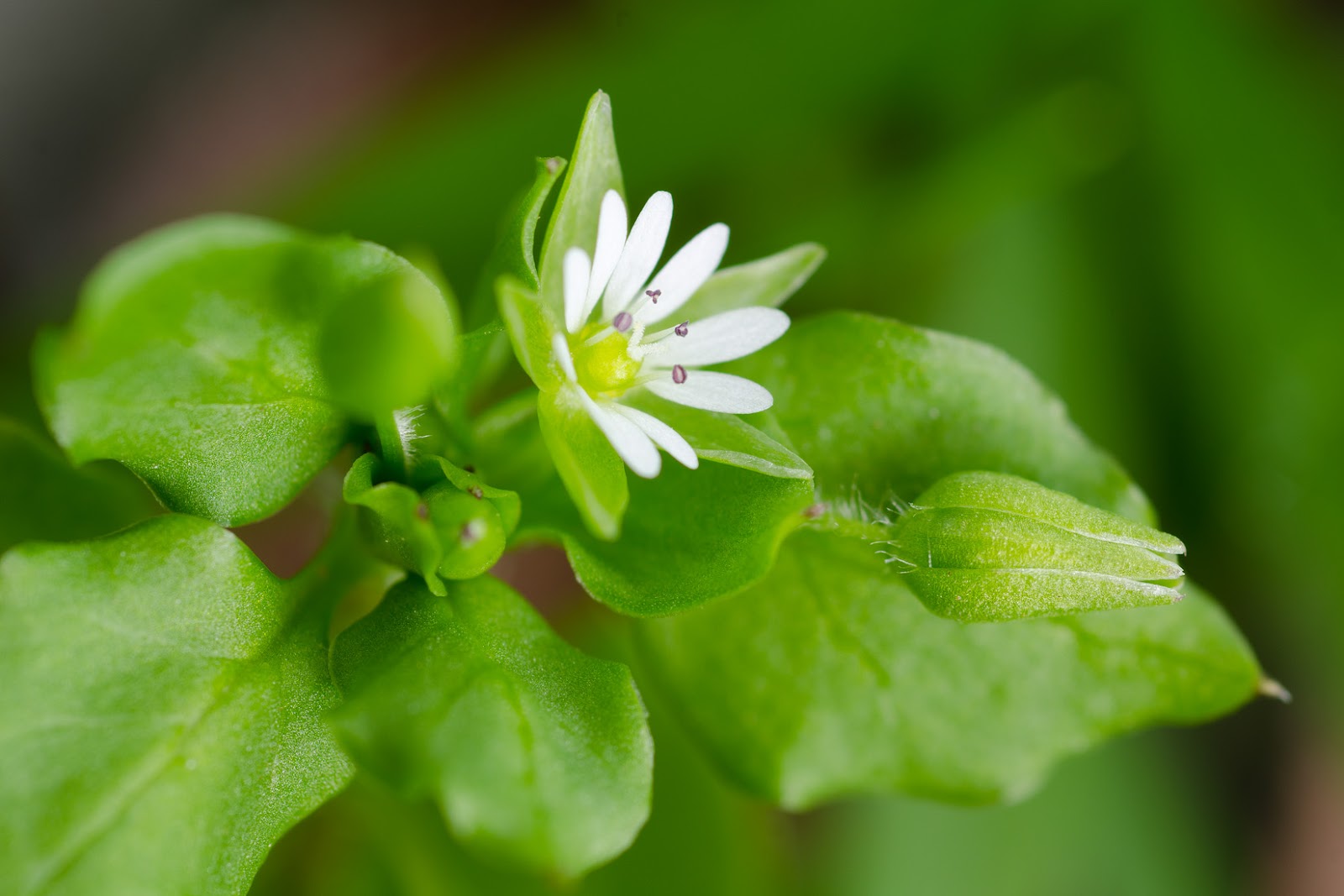
Chickweed (Stellaria)

Chickweed (Stellaria)


Chickweed Jr. Spaghetti Tank
$27.99


The Wildman who promotes all things Chickweed (from women's tanktops to pots of the steamed yard weed) offers this advice on preparing the plant to eat:

FOOD USES: Chop common and star chickweed, and add them, raw, to salads, or cook them like spinach. Mouse-ear chickweedís so hairy, you have to cook it.
Chickweed gets its common name because chickens love it. Raw, it tastes like corn silk. I demonstrate this to school kids with a chicken imitation, then I grab the herb from the teacher's hand with my teeth and swallow it—corny, but consistent with the plant's flavor!
Cooked, chickweed tastes like spinach. Include any of the species in soups and stews, but cook no more than 5 minutes to prevent overcooking. Unlike most other edibles, the stems, as well as the leaves and flowers, taste good.
Cooking shrinks chickweed by 3/4, concentrating the nutrients and compensating for whatever vitamins cooking destroys.


Henbit (Lamium amplexicaule)

Henbit (Lamium amplexicaule)

Mistletoe (Phoradendron tomentosum) 


Pilobolus left on a pile of dung from an errant cow that strayed onto the place this month.


Please watch this video for the little fungus in action.


Stinging Nettle or Heart-Leaf Nettle (Urtica chamaedryoides)

Urticaria flowering


Persian Speedwell  (Veronica persica)

 Burclover (Medicago minima)


Pennsylvania pellitory (Parietaria pensylvanica) 


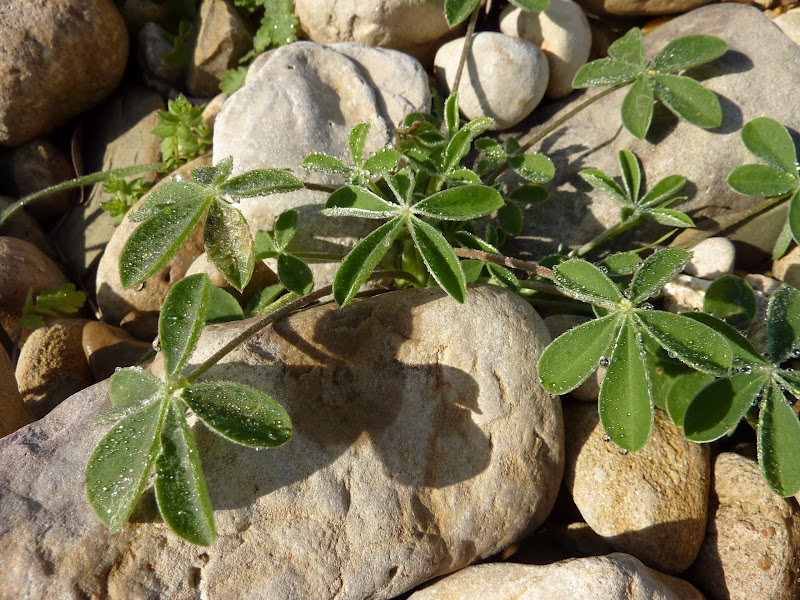
Parietaria pensylvanica or Pennsylvania pellitory.  At this time of year (when it rains enough) it makes soft green clumps all around the fallen branches and the rocks.  Harlin included a picture of the slope (there is a clump behind the rock on the lower right of the photo) and a picture of the leaves.  The plant is wind pollinated and some species have been found to cause an allergic reaction.  So, if you lay on the rocks in your backyard and find you are wheezing, maybe it’s the pellitory.  [Science News, Vol. 137, No. 19 (May 12, 1990), p. 300]


Some of the algae in abundance this season.

Phoradendron tomentosum as the only color
in a rather foggy little canyon

A friend brought us this specimin of Horse Crippler (Echinocactus texensis).
Thank you, Lee.


Thank you, Kate.

An unidentified fruticose lichen among cedar elm leaves littering Whitman's Rough.


January 24 and 25 the rains fell again.  Perhaps three inches.

A nice discussion on a warm January 7 afternoon beside the Creek.


High on a cool and windy January 28.  High.

Gold, Gar, and Geology


Wok


Texas Gold Rush
by Mike Cox

Only four years after thousands of Forty-niners flocked to California in search of riches, a wave of Fifty-threers headed for the Hill Country in a little known and short-lived Texas gold rush.

Word of potential wealth in newly created Burnet County spread across the nation as fast as sailing ships could make it from Indianola and Galveston to New York with Texas newspapers.

“Important from Texas – The Gold Discoveries Confirmed—Great Excitement,” read a one-column headline in the April 20, 1853 edition of the New York Times. That report had been abbreviated from the New Orleans Picayune of April 18. According to the item:

“The news fully confirms the previous reports received of rich discoveries of gold on the Upper Colorado River, and also above Austin. Large amounts had already been collected by those who proceeded to the ‘diggins,’ and the greatest excitement prevailed throughout all Texas.”

Of course, the shining belief that gold – and silver – could be found in the Hill Country dated back to Spanish Texas. Later, colonizer Stephen F. Austin bought into the idea, as did the adventurous scalawag Jim Bowie. While his dreams of wealth ended at the Alamo, the notion persisted that the mineral-rich hills north and west of Austin held untold riches. And for a few months in 1853, it looked like Texas would be the new California.

A week after its first report, the Times offered its readers more details on the Texas bonanza. Reprinting a story from the April 15 Galveston News, the New York newspaper said:

“The steamer James L. Day arrived this morning from Aransas and Matagorda Bays. The most important item of news is the discovery of gold mines in Hamilton’s Valley, above Austin. We have heard rumors of these mines by gentlemen from the interior, but we had occular proof of their existence in a specimen which Captain Talbot exhibited to us this morning. It is a piece of quartz rock, a little larger than a common-sized marble, with pieces of bright gold attached to it. The color of the gold is much clearer than California specimens.”

The newspaper went on to report that “rumors are rife of large quantities of gold being found throughout the western portion of [Texas]” with “great excitement prevailing at Austin, San Antonio, Seguin, Gonzales and other points.” Indeed, several "companies" (used in the 19th century as a synonym for "parties" or "groups") were organized and en route to search for gold.

Though longer, this story offered no further detail on the location of the reported gold find other than in Hamilton’s Valley “and various other places.” Still, the final information in the story doubtless contained all the information seekers of wealth needed to read: “One person sold a piece of quartz in San Antonio for $25.” Back then, $25 had the purchasing power of $780 today.

A month later, the Texas gold rush continued to make national news.

“The latest news from Texas will excite all those who desire to make money in any other than the natural way—by hard work of the hands and brain,” began a piece in the Alton, Ill. Weekly Courier of May 20, 1853. The Illinois newspaper went on to reprint an item from the Lavaca Commercial (a long-extinct Port Lavaca sheet) that actually offered some detail on Texas’ new-born mining district.

“There are now from 300 to 400 persons at work in the mines, and we learn that they are averaging from $5 to $10 per day each, and some few of them have already succeeded in gathering as much as $1,500 to $2,000 worth of gold.”

Austin’s Texas State Gazette weighed in with a report that up to 500 people were hard at work digging for gold “in our neighborhood,” including one operator who in two days “obtained $500 worth of gold.” Noting that the gold play was “easy of access from this city,” the newspaper continued that “we shall not be surprised to hear soon of discoveries equalling in importance the golden stories of California.”

On July 3, 1853 Burnet County pioneer Logan Vandeveer, a Kentuckian who had fought in the Texas Revolution, wrote his father that there was “some excitement in this country about gold mines and other minerals.” He continued: “I cannot see how it will turn out. The people come here in great quantities. Some of them return and some and others remain. It could be the means of selling this country.”

Despite all the hoopla, at least one out-of-state newspaper editor had his doubts about the purported gold discoveries in Texas.

“This reads very much like a hum,” the Milwaukee’s Weekly Wisconsan had observed on May 18. By “hum,” the writer meant humbug, as in hoax or fraud.

Alas, even if all that glitters IS gold, that particular precious metal has to be available in real plentitude to sustain a boom. While some apparently did find some gold, by summer of that year reports concerning the great Texas gold fields had disappeared from the newspapers.

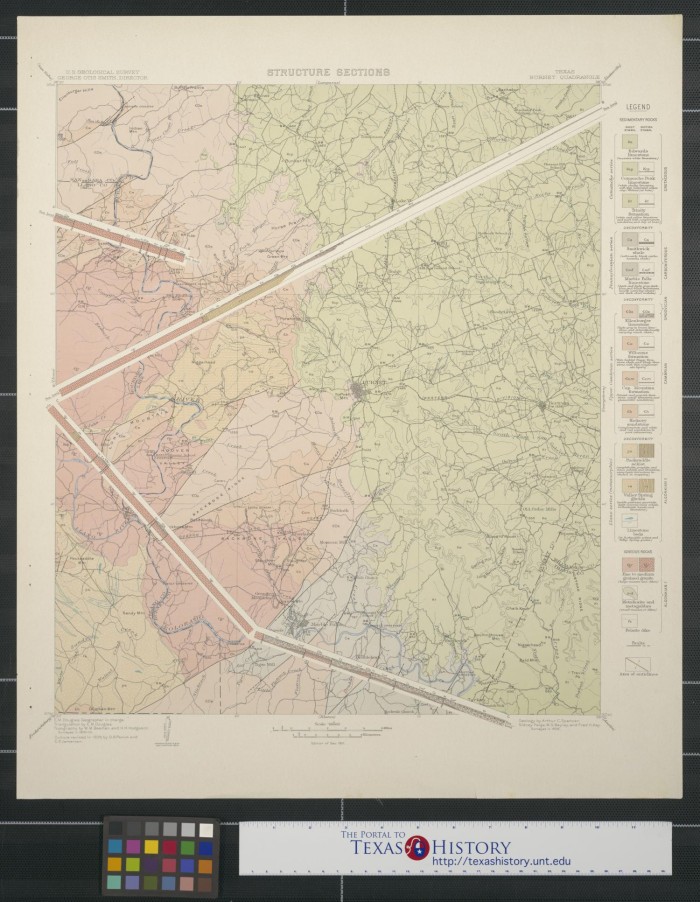
Though the Hill Country did not prove to be the new El Dorado, gold has been and can be found in the beds of various streams feeding into the Colorado above Austin, including Hamilton Creek in Burnet County. But while geologists have long since concluded that the mineral-rich region (with Llano County being the epicenter) does have gold deposits, it does not exist in commercial quantity.

Still, with the current price of gold being $1,400-plus an ounce…. 

© Mike Cox - 
July 14, 2011 column

http://www.texasescapes.com/MikeCoxTexasTales/Texas-Gold-Rush.htm


Spotted Gar (Lepisosteus oculatus)

     Spotted gar.  I think.  The images here are difficult to work with, and the camouflage is admirable, but it's certainly not an alligator gar, and about the only other option is a longnose gar which actually has about as long of a nose as that of the spotted gar and lacks the brown skin and spots of the latter. This one was slowly moving around on the bottom of the pool.  After our four-inch rain awhile back, all the bluegill and other fish we had come to know down in the pool were washed out and exchanged for this single gar, a medium-sized carp, and three odd light-colored fish that circle in a slow triangle nose-to-tail for hours on end.

Spotted Gar (Lepisosteus oculatus)


Harlin's find during his gold panning experience


Water willow
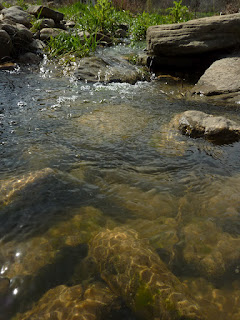
     The Creek remains at its normal level of water flowing out of a Pond that's resting at its own normal level, several inches up the water-meter stick.  
     I am tempted to intervene and "restore" the Creek and its environs to what I imagine to be their natural state.  In other words, if a small juniper or sycamore lies bent because of a flood's current, then I want to right the tree.  If debris hangs from a limb, I want to remove it.  If fish have been washed out of the Pool, I want to restore them.  If a plant died in the drought, I want to yank it out of the ground.  But restoration to what?  Drought and flood have shaped this valley, these hills, and everything about this creek.  
     So I pull my thoughts back to what "natural" means in the context of a world of flux.  If I have to look at a brown and then a gray juniper for the remainder of my days, then I will still be looking at nature as much as if I had replaced it with a green tree.  
     Everything is in flux; everything is graying; everything is shifting, silting, piling up, wearing down, eroding, breaking, going away, and coming to.  Now we will make room for such an appreciation.


Window trim going up.  Siding next.

Tongue-and-groove No. 2 yellow pine for the ceiling.